
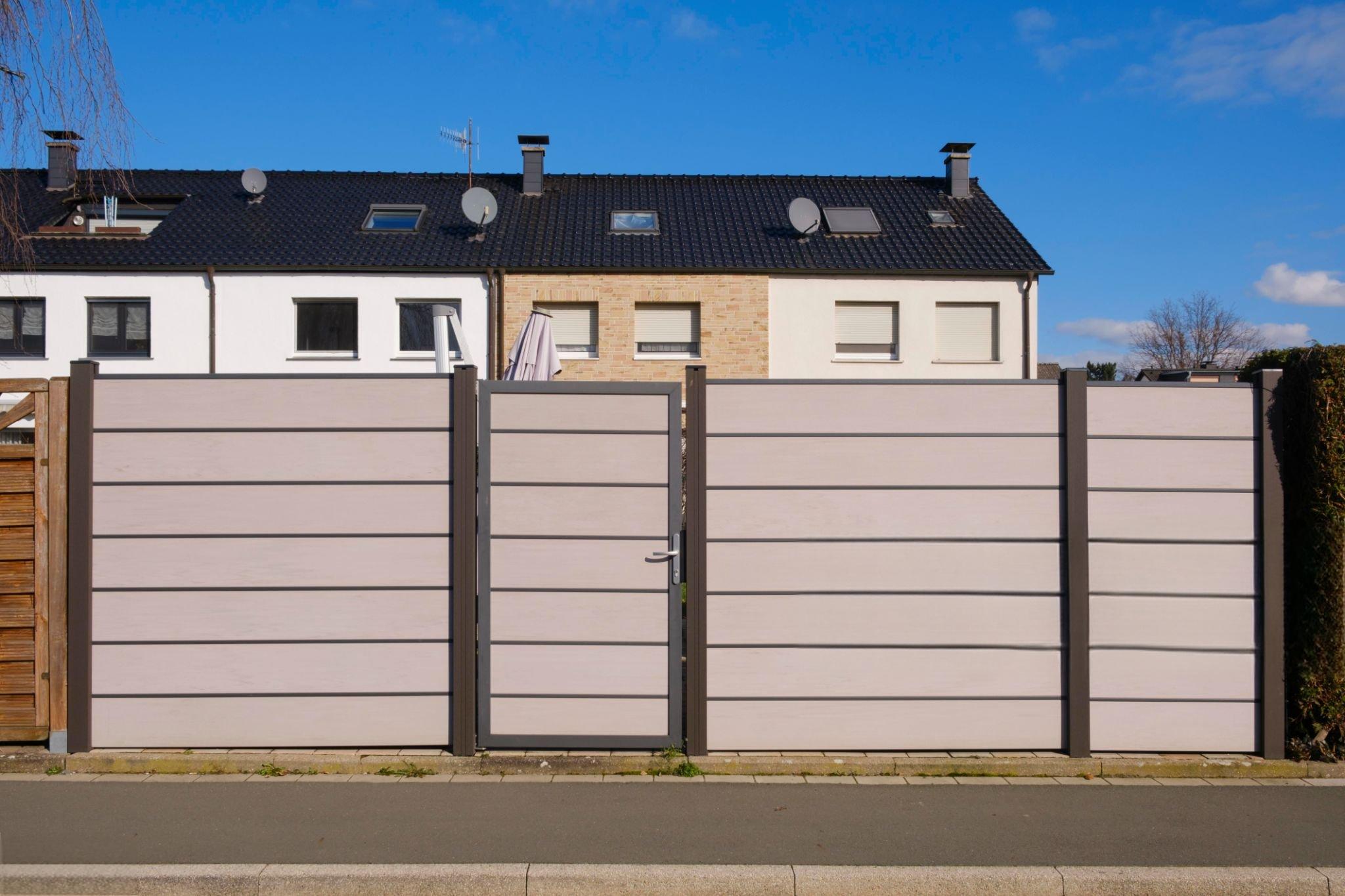
Choosing between powder-coated and anodized finishes for an Aluminum Privacy Fence Panel is a critical technical and strategic decision in urban infrastructure projects. For information researchers, engineers, project managers, and procurement decision-makers, this choice impacts durability, maintenance, aesthetics, corrosion resistance, and long-term lifecycle cost. This article compares both finishing methods head-to-head—addressing environmental exposure, urban pollution levels, installation context, and compliance requirements—so you can specify the right finish with confidence, whether prioritizing performance, sustainability, or total cost of ownership.
How Urban Exposure Dictates Finish Selection
Urban environments subject aluminum fence panels to complex stressors: airborne chlorides from de-icing salts, sulfur dioxide and nitrogen oxides from traffic emissions, particulate matter (PM2.5), and cyclic thermal loading from concrete heat islands. These factors accelerate electrochemical degradation—especially at cut edges, fastener interfaces, and micro-scratches.
Anodizing forms a dense, integral oxide layer (typically 15–25 µm thick) that resists atmospheric corrosion but offers minimal protection against mechanical abrasion or chloride-induced pitting in coastal-adjacent cities. Powder coating provides a thicker polymer barrier (60–120 µm), with UV stabilizers and anti-graffiti additives—critical where panels face direct sunlight, graffiti risk, or frequent cleaning cycles.
Field data from NYC DOT and Toronto Water Infrastructure shows powder-coated panels retain >90% gloss retention after 5 years in high-traffic corridors, while anodized units show measurable etching within 3 years near transit hubs with heavy brake dust accumulation.
Key Environmental Thresholds Influencing Choice
- Average annual chloride deposition >30 mg/m²/week → powder coating strongly preferred
- Annual PM2.5 concentration >12 µg/m³ → anodized surfaces require quarterly pH-neutral cleaning to prevent staining
- Direct solar exposure >1,800 kWh/m²/year → UV-stabilized polyester powder systems reduce chalking by 40% vs. standard epoxy hybrids
- Winter de-icing salt application within 500 m → anodized finishes need ASTM B580 Class II sealing; powder coatings must meet AAMA 2604 specification
Performance Comparison: Corrosion Resistance, Maintenance & Lifecycle Cost
Corrosion resistance isn’t binary—it’s about failure mode, inspection frequency, and remediation feasibility. Anodized aluminum fails via localized pitting at defects, often invisible until structural integrity is compromised. Powder-coated systems fail via film delamination or edge creep, which are visually detectable during routine 6-month site audits.
Maintenance intervals differ significantly: anodized panels typically require professional re-sealing every 7–10 years in moderate climates, whereas powder-coated units need only surface washing every 3–6 months. Over a 25-year infrastructure lifecycle, this translates to ~3 scheduled maintenance events for anodized vs. 12–15 for powder-coated—but labor cost per event is 3× higher for anodized reconditioning.
The table confirms powder coating delivers superior barrier protection under aggressive urban conditions—particularly where maintenance access is restricted (e.g., elevated rail corridors or security-perimeter fencing). However, anodizing remains viable for low-traffic, sheltered applications like courtyard enclosures with controlled access and biannual inspections.
Procurement Decision Framework for Project Managers
Selecting the right finish requires evaluating three interdependent dimensions: exposure severity, inspection capability, and budget horizon. Projects with 10+ year capital planning cycles benefit from powder coating’s lower TCO despite 15–20% higher upfront material cost. Conversely, short-term pilot installations (<3 years) may favor anodizing for faster lead times (7–10 days vs. 12–18 days for custom powder batches).
Procurement teams should verify supplier capabilities beyond catalog claims: request certified test reports for AAMA 2603/2604/2605, confirm salt spray validation on actual fence panel substrates (not flat test coupons), and validate color consistency across production lots using CIE L*a*b* tolerances (ΔE ≤ 1.5).
5 Critical Procurement Checks Before Specification
- Verify coating adhesion meets ASTM D3359 Tape Test ≥ 4B rating on extruded 6063-T5 profiles
- Confirm film thickness is measured at 3 locations per panel (top/mid/bottom) with ±5 µm tolerance
- Require batch-specific spectral reflectance data for color matching against RAL or Munsell standards
- Validate warranty covers both material defect and field-applied damage (e.g., impact, abrasion)
- Ensure supplier provides full traceability: alloy batch, temper, anodize bath parameters, or powder lot number
Why Partner With a Specialized Aluminum Fabricator
Specifying aluminum privacy fence panels isn’t just about finish selection—it’s about integrated system performance. Our team supports your decision with: real-time corrosion modeling for site-specific exposure profiles; AAMA-compliant finish validation on your exact extrusion geometry; and rapid prototyping (3–5 business days) for finish mockups under local lighting and pollution conditions.
We provide full documentation packages—including ISO 9001-certified process records, third-party salt fog test reports, and maintenance protocols aligned with ASTM E2827—for seamless municipal review and QA/QC sign-off. For urgent infrastructure timelines, we maintain stock of common 6063-T5 fence profiles with pre-qualified powder coating options (lead time: 8–12 days).
Contact us to discuss your next urban infrastructure project: we’ll help you confirm optimal finish selection, validate compliance with local building codes (e.g., NYC BC §2609.4, Chicago Municipal Code §13-12-020), coordinate sample submissions, and align delivery schedules with your construction phasing—down to the week.
Please give us a message