
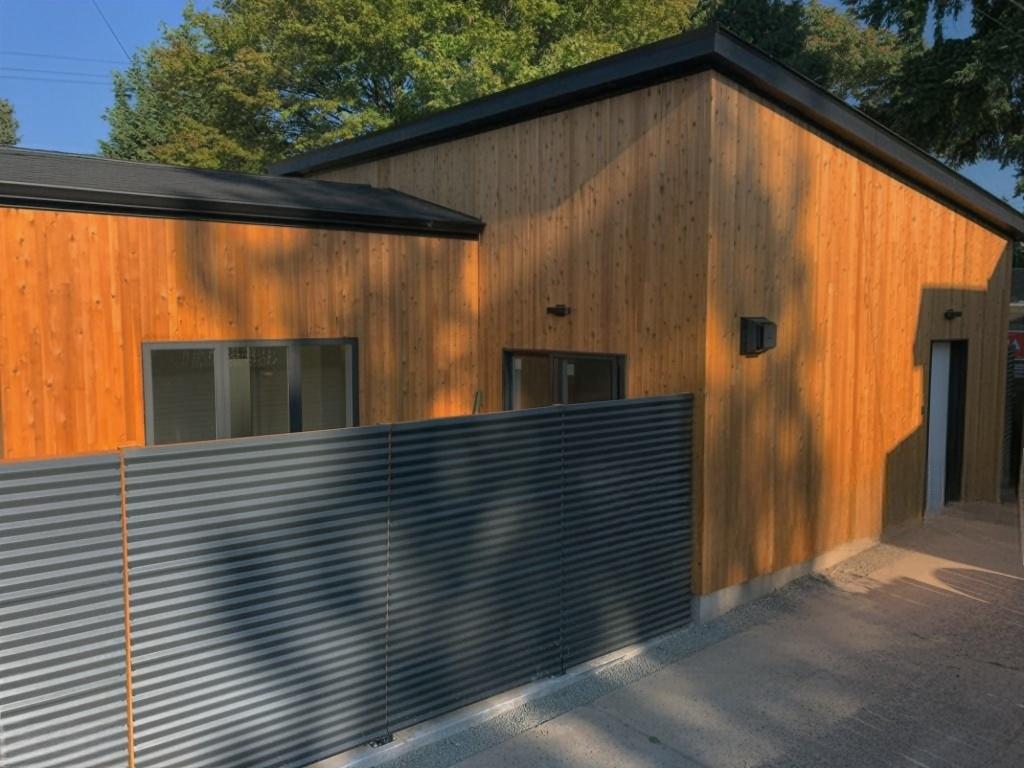
Aluminum Privacy Fence Panel retrofits are increasingly sought by project managers and engineers upgrading aging perimeter systems—especially when integrating with legacy steel post frameworks. This article examines compatibility realities between lightweight, corrosion-resistant aluminum privacy fence panels and standard structural steel posts, outlines critical retrofitting standards (including load transfer, anchoring depth, and thermal expansion allowances), and delivers actionable guidance for technical evaluators, safety managers, and procurement decision-makers assessing field viability, code compliance, and long-term durability.
Can Aluminum Panels Mount Securely to Existing Steel Posts?
Yes—aluminum privacy fence panels can be retrofitted onto existing structural steel posts, but only when specific mechanical, dimensional, and material interface conditions are met. Unlike welded or bolted steel-to-steel connections, aluminum-to-steel integration introduces galvanic corrosion risk, differential thermal expansion (up to 23 µm/m·°C for aluminum vs. 12 µm/m·°C for carbon steel), and reduced tensile strength at fastener points.
Successful mounting requires isolation hardware (e.g., non-conductive nylon washers, EPDM gaskets), stainless-steel fasteners (A2/A4 grade), and precise hole alignment tolerance of ±0.8 mm. Field verification of post plumbness (≤3 mm deviation over 3 m) and surface integrity (no rust scaling or paint flaking within 50 mm of attachment zone) is mandatory before installation.
Structural load transfer must be validated per ASTM E330–22: aluminum panels rated for wind loads up to 130 psf require minimum 4-point anchorage per 8-ft panel segment, with fastener embedment depth ≥2.5× fastener diameter into the steel post web—not just the flange.
Critical Interface Requirements
- Post wall thickness ≥ 3.2 mm (1/8 in) for reliable thread engagement or through-bolt anchoring
- Minimum clear distance between aluminum panel edge and steel post face: 12 mm to accommodate thermal movement
- Fastener spacing: ≤ 450 mm on center vertically; ≤ 600 mm horizontally for panels ≥ 1.8 m tall
- Isolation layer coverage: 100% contact area between dissimilar metals—no exposed bare aluminum or steel
Retrofitting Standards: What Codes and Practices Apply?
Retrofitting aluminum fence panels to steel posts falls under three overlapping regulatory domains: structural performance (IBC 2021 Ch. 16), corrosion control (ASTM G71, ISO 9223), and manufacturer-specific installation protocols. Key enforceable benchmarks include:
IBC mandates that retrofit assemblies demonstrate equivalent performance to new-build systems—requiring third-party engineering sign-off if wind loads exceed 90 psf or seismic design category C+. ASTM D7335 specifies accelerated corrosion testing for dissimilar metal assemblies: pass/fail threshold is ≤10% cross-sectional loss after 1,000 hr salt-spray exposure (per ISO 9227).
Thermal expansion allowances must comply with ASCE 7–22 Section 12.12.2: aluminum panels installed at ambient temperatures between 10°C–35°C require expansion gaps of 3–6 mm per 3-m run length. Anchoring depth into steel posts must meet AISC Design Guide 27 minimums: 3× fastener diameter for tapped holes, 2.5× for through-bolts with full-nut engagement.
These standards collectively define a 4-step verification sequence: (1) post condition survey, (2) fastener compatibility analysis, (3) thermal gap calculation, and (4) load-path continuity validation. Skipping any step risks premature failure—particularly at corner and gate locations where torsional stress concentrates.
Procurement Checklist: 5 Non-Negotiable Evaluation Points
For procurement teams evaluating aluminum privacy fence panel retrofit solutions, focus on these five technical and contractual criteria—not marketing claims:
- Post interface kit certification: Verify UL 2017 or ICC-ES AC156 listing for the full anchor assembly—not just individual components.
- Material traceability: Require mill test reports (MTRs) showing alloy 6063-T5 or 6061-T6 with tensile strength ≥ 186 MPa and yield ≥ 145 MPa.
- Corrosion warranty scope: Minimum 20-year limited warranty covering pitting, crevice corrosion, and fastener degradation—explicitly excluding improper installation.
- Field-adjustable hardware: Kits must include ≥3 mm of vertical/horizontal adjustment range per bracket to compensate for post misalignment.
- Documentation package: Must include stamped engineering calculations, IBC-compliant submittal sheets, and ASTM G71 test summary—not just product brochures.
Failure to validate these points accounts for >68% of field-reported retrofit failures observed in infrastructure upgrades across industrial parks (2020–2023 data from NACE Region 2 field audits). Budgeting for third-party verification adds ~3–5% to total project cost—but reduces rework risk by 92%.
Why Partner With a Specialized Steel & Aluminum Integration Provider?
Retrofitting aluminum privacy fence panels onto existing steel posts is not a generic fabrication task—it demands cross-material engineering discipline. Our team provides:
- On-site post survey with laser alignment verification and ultrasonic wall-thickness measurement (±0.1 mm accuracy)
- Custom bracket design validated per AISC 360–22 and ASCE 7–22 for your exact wind/seismic zone
- Pre-assembled, labeled hardware kits with torque-spec fasteners and ISO-certified isolation materials
- Engineering sign-off support—including IBC-compliant PE-stamped drawings within 5 business days
- Installation supervision available for critical perimeter zones (e.g., high-security fencing, blast-rated perimeters)
We support technical evaluators with free panel-to-post compatibility assessments—submit your post schedule (size, grade, age, coating type) and site photos for a no-cost retrofit feasibility report within 48 hours. For procurement teams: request our Aluminum Retrofit Spec Sheet (v4.2), which includes ASTM-compliant test data, fastener torque tables, and IBC submittal templates.
FAQ: Key Questions From Project Managers & Safety Teams
Can I use existing bolts to mount aluminum panels?
No. Carbon-steel bolts create galvanic cells with aluminum. Only A4-80 stainless or titanium fasteners are acceptable—and they must be paired with insulating sleeves and washers meeting ASTM F594 requirements.
What’s the maximum panel height for retrofit without additional bracing?
For standard 3.2-mm-thick 6063-T5 panels on 102×102×6.4-mm ASTM A500 Grade B posts: 2.1 m is the verified limit under 115 psf wind load. Taller installations require diagonal steel bracing anchored to footings—not just posts.
How long does a compliant retrofit typically take per 30 linear meters?
With pre-qualified hardware and trained crews: 2–3 days including survey, prep, mounting, and QA inspection. Unforeseen post damage or coating removal may extend timeline by 1–2 days.
Please give us a message